How to Handle COI Requests Faster Without Losing Accuracy
An additional insured is a person or organization that receives coverage under someone else’s liability policy, usually because a contract requires it. For agencies, MGAs, brokers and carriers, the work lies less in the definition than in verification: confirming that the endorsement or certificate wording matches what the contract demands. Acord AI builds workflow automation for this kind of document checking, with human review of every decision.
An additional insured is an individual or company added to the named insured’s CGL policy for a specific purpose. Often a contract requires the contractor to include the owner or consultant, as CCDC Bulletin 4 describes. CCDC is the Canadian Construction Documents Committee, which publishes the standard construction contracts used across the country.
The status is a risk-transfer tool. Indemnity clauses give contractual protection on paper, while being named on the other party’s policy gives the requesting party an insurer with a duty to respond. Soloway Wright’s analysis of additional insured covenants says the most frequently required insurance in Canadian commercial contracts is CGL, usually in an amount of $2,000,000 to $5,000,000.
Additional insured status applies to liability coverage only. MEARIE’s contract management guide states that it cannot be provided under a property or vehicle policy.
The named insured is the policyholder identified in the policy. According to Aviva Canada, that party generally has the broadest protection and the responsibility for keeping the policy in force. An additional insured is a third party whose protection is shaped by the policy limits, exclusions and endorsement wording.
The Municipal Insurance Association of British Columbia adds that an additional insured does not pay premiums and is typically covered only for claims arising from the named insured’s operations.
| Point | Named insured | Additional insured |
|---|---|---|
| Relationship to policy | Policyholder | Third party added by endorsement or policy wording |
| Scope of protection | Broadest | Limited to the endorsement’s terms |
| Premium | Pays | Does not pay |
| Policy upkeep | Responsible | Not responsible |
| Typical trigger | Own operations | Named insured’s operations, contract or relationship |
A standard CGL policy does not itself define the term. Under IBC CGL 2100, Section II, “Who Is An Insured”, coverage for an added party depends on the endorsement wording, according to CCDC Bulletin 4. The same bulletin explains that the phrase “only with respect to the operations of the Named Insured” refers to the named insured’s contract. It does not mean the named insured must have performed the act that caused the injury.
Three wording points decide most outcomes:
Cost and limits also matter. Aviva Canada notes that adding an additional insured may affect premium, underwriting or policy terms. Some endorsements carry no charge, while others involve a fee or insurer approval. The named insured and the additional insured can share the policy’s limits and defence resources.
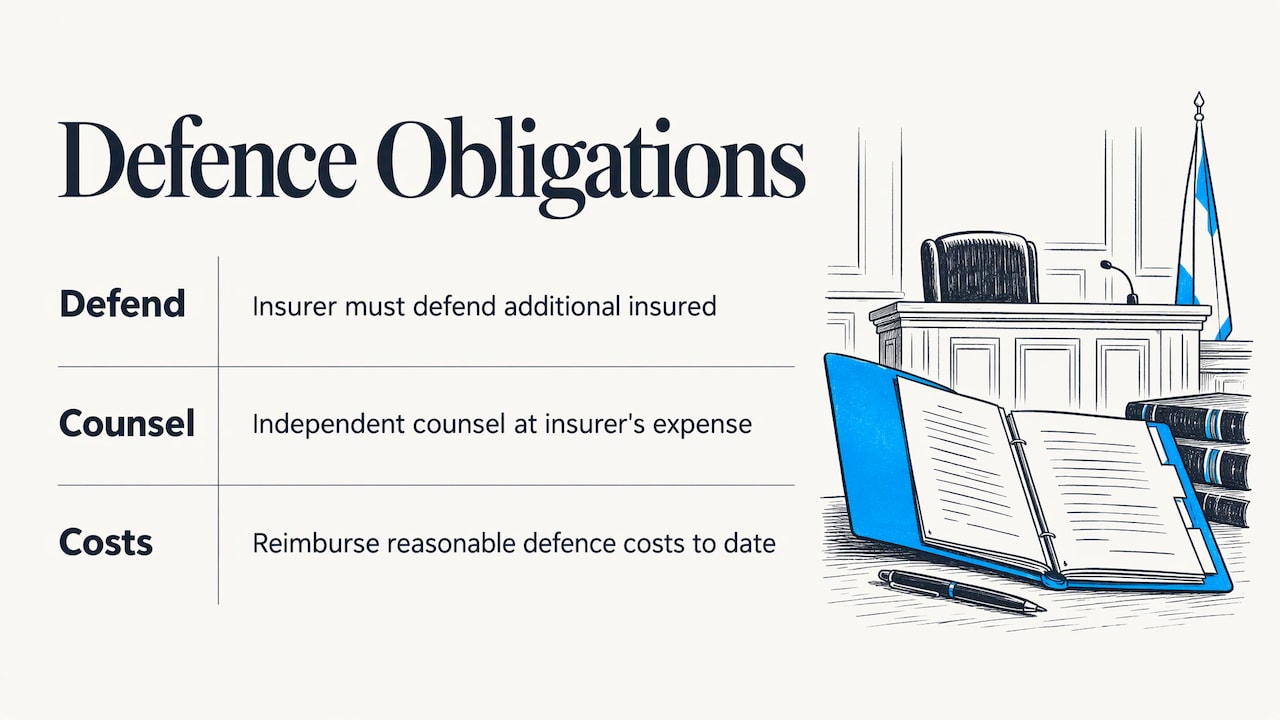
In Carneiro v. Durham (2015 ONCA 909), the Ontario Court of Appeal held that the insurer had to defend the additional insured, provide independent counsel at its expense and reimburse reasonable defence costs incurred to that point, per the Blaney McMurtry summary. The case shows why precise wording is worth the effort: the status carries a real defence obligation when properly documented.
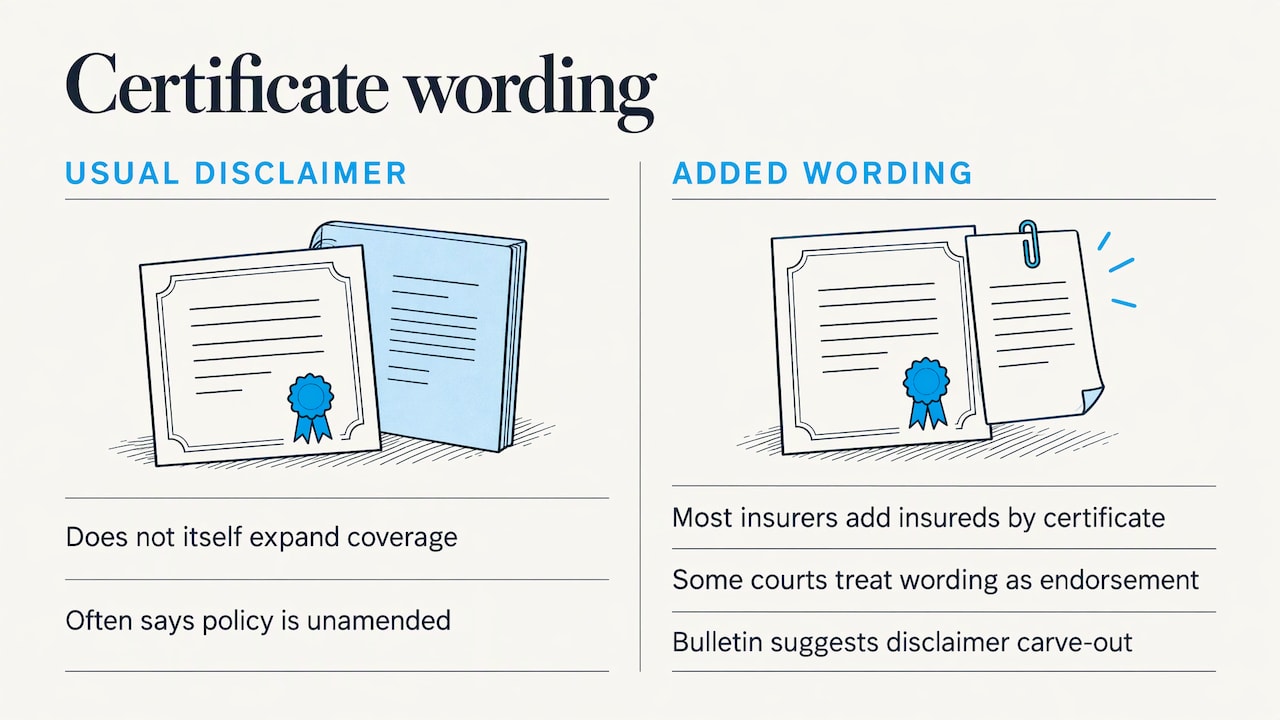
A certificate of insurance is a snapshot of coverage. Aviva Canada states that it does not by itself create or expand additional insured coverage, and that it often says it does not amend, extend or alter the policy. The practical rule is to request the endorsement and compare it with the contract.
Canadian practice is less tidy. CCDC Bulletin 4 notes that most Canadian insurers add additional insureds through certificates with added wording rather than a formal endorsement. A few recent decisions have treated that wording as equivalent to an endorsement. The bulletin suggests certificate language that carves out additional insured clauses from the usual information-only disclaimer. A reviewer therefore has to read the certificate’s wording as closely as the policy’s.
The consequence of a missed requirement is concrete. In Brookstreet v. Economical (2018 ONSC 80), a party contractually entitled to additional insured status but never added had no privity of contract with the insurer. Per Soloway Wright, it could only sue the breaching party for damages and had to hire its own lawyer to defend the underlying claim.
Aviva Canada identifies two recurring triggers:
Equipment and service agreements follow the same pattern. A business that rents out trailers, for instance, has its own view of what insurance a renter needs, and the same logic of confirming protection before work starts applies to contract partners. Property-side controls matter too: a commercial fire risk assessment is one input into how a liability insured manages its premises, and so into what a policy ultimately has to respond to.
Whoever places or reviews the policy faces the same sequence. At each step the manual version is slow and error-prone, which is where automation helps.
Policy IQ handles the second and third steps: it is built for policy checking and comparison, identifying discrepancies against source documents and routing them to a reviewer. The wider approach is described in our insurance coverage analysis guide and our piece on document review automation.
Additional insured work is document comparison under time pressure. A request arrives by email, the certificate has to be issued or checked, and the contract clause sits in a different file from the policy wording. Errors enter at the hand-offs.
Our position is that routine comparison should be automated and judgment should stay with people. Acord AI combines automation with human oversight and configurable workflows, so a team can set what counts as an exception and have each one reviewed before anything goes out.
For certificate volume, Cert IQ handles certificate requests. For policy wording, Policy IQ supports checking and comparison. Inbox IQ manages the inbound email where these requests start. Together they connect to industry systems, so staff spend their time on the cases that need an expert.
the author
Acord AI offers Cert IQ for certificate request handling, Policy IQ for policy checking and comparison, and Inbox IQ for email and request management. The full set is on the solutions page. Each workflow keeps a human reviewer in the decision.
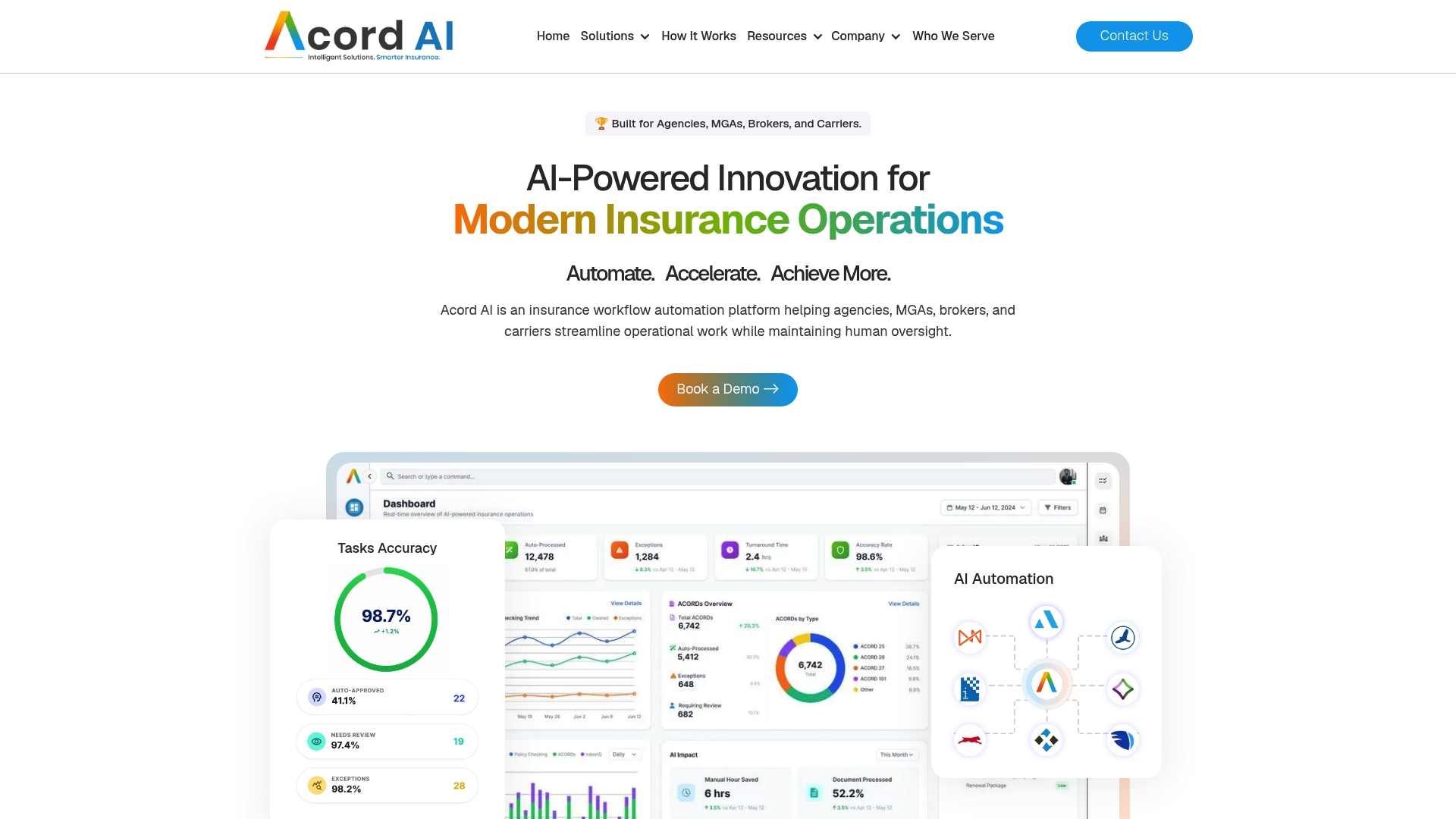
To see how these fit your agency, MGA, brokerage or carrier operation, book a demo through Acord AI.
No. The named insured is the policyholder, with the broadest protection and responsibility for the policy. An additional insured is a third party with limited protection, defined by the endorsement wording and the named insured’s operations.
Not by itself. Aviva Canada states that a certificate is a snapshot and often says it does not amend the policy. Canadian practice varies, so compare the certificate wording and the endorsement with the contract.
Liability coverage. MEARIE states that additional insured status cannot be provided under a property or vehicle policy, so the request belongs on the general liability policy.
Landlords on commercial leases and general contractors on job sites are the most common, according to Aviva Canada. Project owners and consultants under CCDC contracts also require it.


One Platform. Smarter Insurance Operations. Start Your Journey Today.