How to Handle COI Requests Faster Without Losing Accuracy
Insurance knowledge management is the discipline of capturing what your people know about policies, carriers, forms and procedures, assigning an owner to each piece, and placing it where staff can retrieve it while they work. For agencies, MGAs, brokers and carriers, the practical test is simple: when a service rep gets a question about an endorsement or a certificate request, the answer should come from a governed source in minutes, not from whoever happens to remember it. Acord AI approaches this by connecting an insurance knowledge assistant, Ask AIVA, to workflows that keep human review in the loop, so knowledge is used inside the work and not stored beside it.
Most agencies already have a knowledge system. It is a mix of shared drives, old emails, carrier portals, personal notes and the memory of two or three senior people. Knowledge management replaces that informal arrangement with a deliberate one: a defined set of content, a clear owner for each item, a consistent place to find it and a routine for keeping it current.
The need is sharper in insurance than in many industries because the material changes constantly and errors are costly. Policy forms are revised, carriers shift appetite, and regulators update expectations. A wrong answer about coverage can become an errors and omissions claim.
The regulatory frame in Canada points the same way. The Canadian Council of Insurance Regulators (CCIR) and the Chief Insurance Regulators Organization published guidance on the conduct of insurance business and fair treatment of customers in September 2018. It defines “intermediary” broadly, covering individual agents, brokers and representatives as well as managing general agencies and third-party administrators. It expects insurers and intermediaries to put policies and procedures for fair treatment of customers in place as part of their business culture. Written, findable procedures are the most direct way to show that this is happening.
Start with what people ask each other most often, not with what is easiest to document. A useful inventory has five groups.
Product and policy knowledge. Coverage forms, common endorsements, exclusions, how coverage differs by line of business and how to read a carrier’s wording. This is where discrepancies between a quote, a binder and an issued policy tend to originate.
Carrier and market knowledge. Appetite, minimum premiums, submission requirements, preferred contacts and turnaround expectations. For brokers and MGAs, this is what makes quoting and remarketing fast.
Procedures. How a certificate request is handled, how a renewal is reviewed, what must be checked before an application is submitted, and who approves exceptions. These are the processes you want to standardize.
Regulatory and compliance knowledge. Provincial licensing rules, fair treatment obligations, privacy requirements and your own internal policies.
Tacit expertise. The reasoning senior staff apply: why one carrier is a better fit for a given risk, which clauses to look at first on a commercial package, which client situations call for escalation. This group is the hardest to capture and the most valuable. Record it as short worked examples, not abstract rules.
Leave out anything nobody will maintain. A smaller base that is accurate beats a large one that is half out of date.

Staff stop using a knowledge base the first time it gives them an outdated answer. Organization should therefore serve two goals: speed of retrieval and visible trust.
| Element | What it should show | Why it matters |
|---|---|---|
| Title and topic | The line of business, carrier or process it covers | Staff search by the task in front of them |
| Owner | A named person or role | Questions about accuracy have a destination |
| Last reviewed date | A date, and the next review date | Staff can judge currency at a glance |
| Source document | A link to the policy form, bulletin or regulation | Answers can be verified against the original |
| Applies to | Province, carrier, product or client segment | Prevents correct answers being used in the wrong context |
Group content by task (“processing a certificate request”, “reviewing a renewal”) before grouping it by carrier or product. Keep one authoritative version of each item and retire copies. Where a procedure has steps, write them as steps, and where a rule has exceptions, state the exceptions beside the rule.
The CCIR guidance supports this routine from the regulatory side: it expects insurers and intermediaries to maintain ongoing training programs so that people giving advice keep appropriate knowledge of their industry segment, product characteristics and risks, and the applicable legal and regulatory requirements. A knowledge base with owners and review dates gives that training a stable, current reference.
A common mistake is to treat the project as a documentation exercise. The Insurance Institute of Canada, in a Canadian Underwriter handbook article published September 29, 2026, argues that insurance has an execution problem more than a knowledge problem: knowing what should happen is different from doing it consistently under real operating conditions. It reports that 50% of the 169 brokers in its 2026 National Broker Survey named rapid technological change as a strong challenge, up 12% from the prior year.
The same article points to unclear decision rights, fragmented ownership and workflows that reward old habits as deeper causes, and it warns that automating a poor workflow accelerates ambiguity. The lesson for a knowledge project is to define the workflow first. Decide who approves an exception, who answers a coverage question that falls outside the documented rule, and what the steps are for a certificate or a renewal check. Then place the knowledge at those steps.
This is also why standardizing processes and sharing knowledge are the same project. When two account managers handle the same request differently, the cause is usually that the procedure was never written down or never attached to the task.
Search inside a folder structure only goes so far. A knowledge assistant lets staff ask a question in plain language and receive an answer drawn from the organization’s own documents. Large Canadian institutions already treat this as a core use. A Manulife presentation at Future of Work Canada 2025 lists knowledge management, meaning easy search and insight from internal knowledge bases, as a main generative AI use case. Manulife’s 2025 management discussion and analysis states that its ChatMFC platform reached 100% global workforce coverage and added integration with key knowledge bases and document upload in 2025.
Speed is only half the requirement. The FIFAI II report from the Global Risk Institute (March 2026) describes hallucinations as a concrete risk, noting that unverified generated figures, statements and references have led to material errors. In insurance, an invented endorsement or an outdated rule is exactly that kind of error. Four safeguards address it:
Acord AI is built around this principle of automation with human oversight. Its platform combines Ask AIVA, the insurance knowledge assistant, with policy checking, ACORD form preparation, quoting support and certificate request handling, so the same workflow that prepares the work also gives staff the knowledge they need to review it.
New hires in insurance spend a long time learning products, carriers and internal procedures. Consistent, task-based knowledge shortens that period because the new employee reads the answer in context instead of interrupting a colleague.
The industry is moving toward consistent orientation. The Insurance Institute of Canada’s 2022-2023 annual report describes its P&C Onboarding course, a self-paced one-hour eLearning module with over 2,000 English and more than 200 French visits in 2022-2023. It also notes that in January 2023 industry CEOs and senior HR leaders asked the Institute for an accelerated program of five modules with 25 to 30 digitized learning objects of four to six minutes each, to give new hires a consistent orientation across the industry. Short, modular content is the pattern to copy internally.
There is also an economic case for investing in learning. A March 2023 report on employer-sponsored skills training, drawing on a study of 3,528 firms from 1999 to 2005, found that each additional dollar per employee spent on training in finance and insurance raised labour productivity by more than $47. The data are historical and cover training broadly, but they show why reducing the cost of getting people productive is worth the effort.
For an agency, a practical onboarding path looks like this:
Making internal knowledge searchable also makes mistakes in permissions searchable. Client files, claims details and personal information must not surface for people who have no reason to see them, and they should not be pasted into tools that are not approved.
The OSFI and FCAC risk report on AI uses and risks, published September 24, 2024, identifies data privacy, governance and quality as concerns across the data lifecycle and says AI models must be explainable. Its list of safeguards includes human-in-the-loop controls, performance monitoring, limits on the use of personal information and preventing confidential data from entering prompts. It also records that Sun Life scanned knowledge articles for personal information and restricted data before evaluating a large language model. The same report cautions that risk management often lags the speed of AI adoption, and that insufficient AI training for the people who use the technology and for senior decision makers can lead to wrong decisions.
A workable governance checklist for an agency or MGA:
Large organizations show what accountability looks like. Manulife’s 2025 MD&A describes technology and cyber risk governed by its chief information security, technology, information risk and privacy officers, with access control, vulnerability management and security awareness training for all employees. OSFI’s 2024-25 annual report says it released an AI strategy, an acceptable use policy and an ethics code of conduct, built a use-case governance process and ran mandatory training on AI ethics, prompt engineering and information governance. A smaller agency does not need that scale, but it needs the same elements in proportion. Further reading on AI risk management beyond checkbox compliance covers how audit trails and access policies fit together for AI tools. Acord AI publishes its approach on its security and privacy page.
Set a baseline before the rollout, then track a small number of measures:
Review them monthly for the first quarter. If time to answer improves but errors do not fall, the content is being found but is inaccurate or the workflow lacks a review step. If errors fall but adoption is low, the knowledge sits too far from the task.
Acord AI is an insurance workflow automation platform for agencies, MGAs, brokers and carriers. Its solutions cover automated email and request management (Inbox IQ), policy checking and comparison (Policy IQ), ACORD form preparation (Forms IQ), quoting and remarketing support (Quotes IQ), certificate request handling (Cert IQ) and the Ask AIVA knowledge assistant. Teams configure workflows to match how they operate, the platform integrates with key industry systems, and human review stays in the decision points.
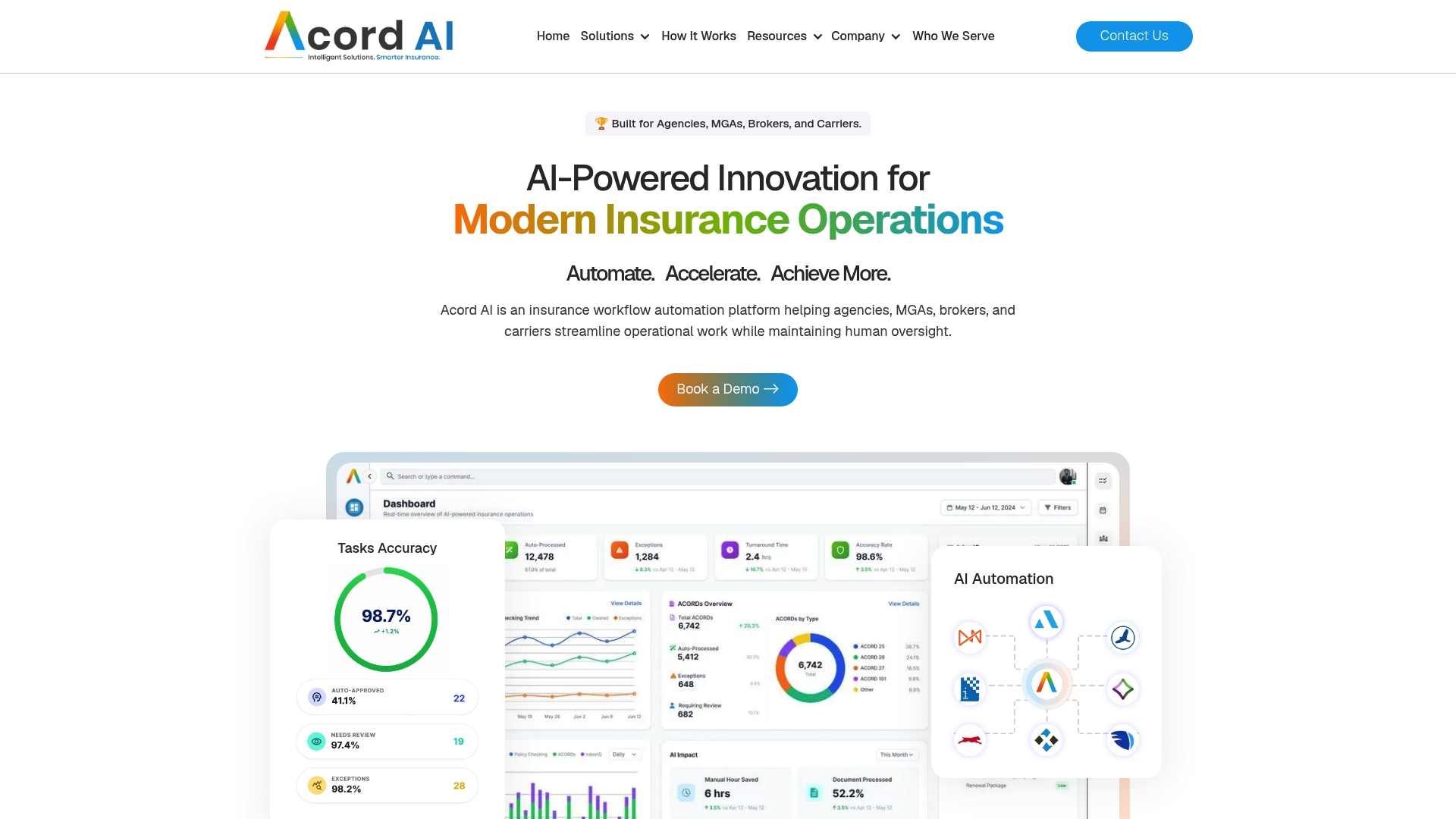
To see how these fit your agency, MGA, brokerage or carrier operation, explore the full set of Acord AI solutions and book a demo from there.
Our perspective
Insurance teams rarely lack knowledge. They lack a dependable way to apply it at the moment a request lands in the inbox. A policy checker needs to know what a compliant wording looks like, a quoting team needs to know a carrier’s requirements, and a service rep needs the right procedure for a certificate. When that knowledge sits in separate places, people fall back on memory, and memory varies from person to person.
That is why we build knowledge into the workflow instead of beside it. Acord AI combines intelligent automation with human oversight and configurable workflows, so repetitive work is handled consistently and your people review the decisions that need judgment. Ask AIVA, our insurance knowledge assistant, sits alongside Inbox IQ, Policy IQ, Forms IQ, Quotes IQ and Cert IQ so the same platform that prepares the work supports the person reviewing it.
Our recommendation for any agency starting out is to pick one high-volume workflow, define who owns it, and connect the knowledge to it before expanding. Teams that do this reduce manual workload, improve accuracy and give new staff a clearer route to productive work.
the author
A knowledge base is the content itself: articles, procedures and reference documents. Knowledge management is the whole practice around it, including what gets captured, who owns each item, how it is found, how it is reviewed and how it is used in daily work. A knowledge base without that practice goes out of date quickly.
A first useful version can cover the most frequent questions for one workflow, such as certificate requests or renewal reviews, and does not need to document the whole agency. Expand by workflow once ownership and review routines are working. The ongoing effort of maintenance matters more than the initial build.
Generative models can produce inaccurate statements, which is why answers should be tied to source documents and decisions should keep a human reviewer. Current, well-owned content and a review of unanswered questions further reduce the risk. Acord AI’s platform is designed with human review for decision-making.
Assign a named owner for each topic, usually the person closest to the work, and one coordinator who tracks review dates. In a small agency this can be a senior account manager or the operations lead. Ownership by role is clearer than ownership by committee.
It supports them. CCIR guidance expects insurers and intermediaries to have fair treatment policies and procedures and ongoing training for people who advise customers. A maintained, accessible knowledge base is a practical way to keep those procedures and training materials current. Confirm your provincial licensing obligations with your regulator.


One Platform. Smarter Insurance Operations. Start Your Journey Today.