Insurance Knowledge Management for Canadian Agencies and Carriers
Certificate of insurance (COI) requests slow down for three reasons: they arrive in scattered inboxes, they arrive incomplete, and every certificate has to be checked against the policy before it goes out. The fastest teams fix all three: one intake channel, a fixed set of required details, and automated handling of the routine work, with a person reviewing anything that goes beyond the policy. Cert IQ, part of the Acord AI platform, is built for certificate request handling in exactly this way, with human review kept in the process.
This guide is written for agencies, MGAs, brokers and carriers in Canada. It walks through the request from intake to delivery, shows where time is lost at each step, and explains which parts can be automated and which need a licensed person’s judgment.
COI stands for certificate of insurance. MEARIE describes it as a document issued by an insurer, agent or broker that provides evidence a policy is in force and summarizes key policy details. It is commonly requested as proof of insurance before a project starts or a vendor comes on site.
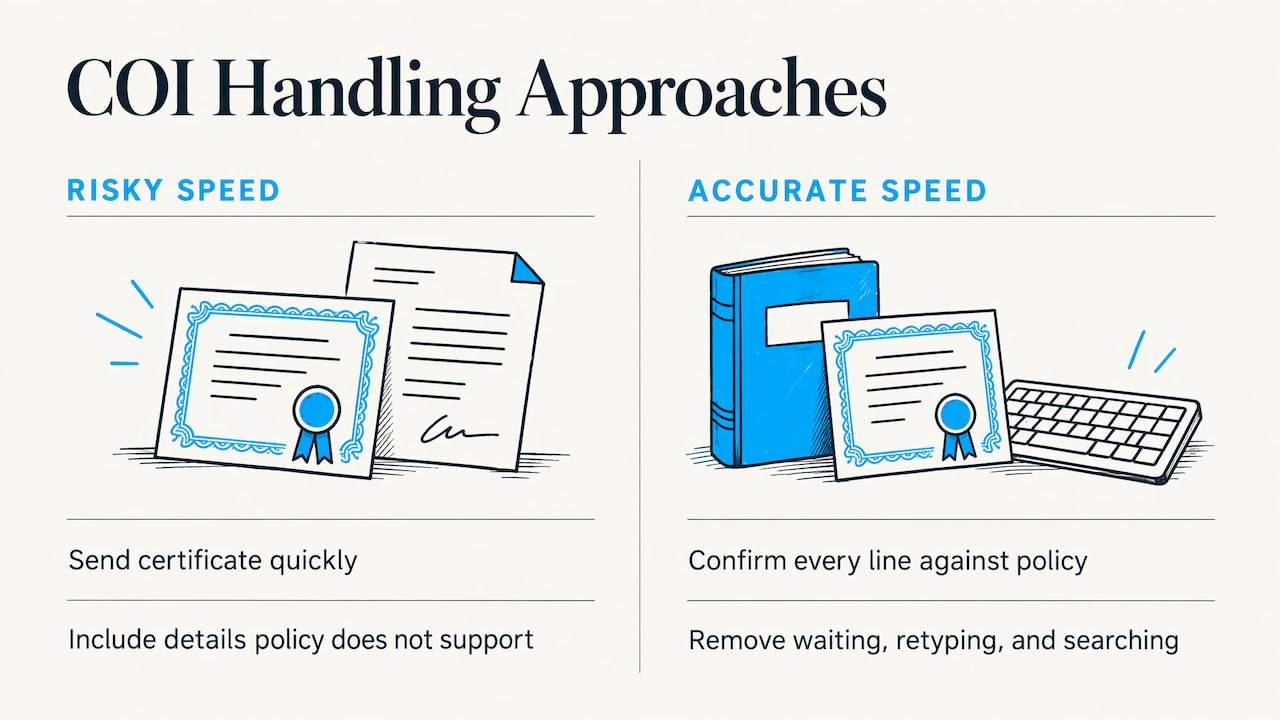
That definition explains why speed and accuracy pull against each other. The requester wants a document quickly, often because a contract or site access depends on it. Your team needs to confirm that every line on the certificate is supported by the policy. A certificate that goes out fast and says something the policy does not support creates an errors and omissions exposure and a dispute at the worst moment, usually after a loss.
Handling requests faster therefore does not mean checking less. It means removing the waiting, retyping and searching that surround the check.
In most offices the delay is not the typing of the certificate. It sits around it:
Each of these can be shortened without touching the quality of the final check.
Aligned Insurance’s guidance tells clients to send requests to a centralized certificates email, and says it issues the certificate when the information is complete and the requested terms fit existing coverage. MEARIE takes the same approach with a portal: its guide advises applicants to use the Insurance Portal, which several team members monitor to support timely processing.
The principle is the same in both: one monitored channel, several people watching it. A request sitting in one producer’s inbox during a vacation is the most common avoidable delay.
For an agency or brokerage, the practical setup is:
Where Acord AI helps: Inbox IQ manages incoming emails and requests, so certificate requests are identified in the stream of messages and routed into the workflow rather than waiting for someone to notice them. The Inbox IQ workflow guide describes how that flow is set up.
A request that arrives incomplete costs at least one round trip, and each round trip can add a day. The checked guidance on what to collect is consistent. MEARIE’s guide lists the details a certificate request needs:
Two points deserve emphasis. First, MEARIE recommends entering a specific date rather than “ASAP”, so the request can be scheduled reliably. A real date lets your team sort a queue by urgency; “ASAP” makes every request equal. Second, MEARIE notes that only one certificate holder can be listed per certificate, so a request naming several holders is really several requests and should be split at intake.
An Ontario association’s STEP by STEP request guide asks for similar information: requester contact details, event details and dates, location, additional insured information and supporting contract documents where they apply. That guide also describes a chain of approval, from a club to its branch, to the issuer and back, with a stated processing time of up to two business days. Published turnaround times like this are useful because they set the requester’s expectation before they ask.
| Detail | Why it matters |
|---|---|
| Named insured, full legal name and address | Identifies the right policy and avoids certificates for the wrong entity |
| Certificate holder, legal name and address | One holder per certificate; the usual source of reissues |
| Required-by date | Lets the team prioritize without guessing |
| Description of work or service | Supports the description of operations on the certificate |
| Contract or agreement number | Ties the certificate to the requirement it satisfies |
| Required limits and coverages | Allows an immediate comparison with the policy |
| Additional insured or other wording requested | Flags the request for review before issuance |
| Insurance requirements section of the contract | Removes the back and forth about what is actually required |
If you want requesters to send a complete package, tell them this list in the auto-reply to your certificates address. Requesters rarely know what you need until you tell them.
Not every certificate deserves the same attention. Aligned’s guidance separates the two cases: a simple “to whom it may concern” certificate based on policy information can be issued quickly, while requests that name a holder or seek additional insured status or specific coverage details need more information.
A practical triage looks like this:
The third category is where most certificate delays are really coverage problems. Telling a client on day one that the contract requires something the policy lacks is faster than discovering it on day four. Our guide to verifying additional insured coverage in Canada explains how to confirm that the policy supports the status being requested before a certificate says it does.
The check is the step that cannot be skipped, and it is also the step where manual work is most repetitive. A reviewer opens the policy and endorsements, finds the limits, dates and named insureds, and compares them to the requested certificate and the contract requirements. Discrepancies are easy to miss when the reviewer is doing this between other tasks.
A reliable check covers:
Here Policy IQ applies. It handles policy checking and comparison, identifying discrepancies between source documents, so the reviewer starts from a list of items to confirm rather than a blank read-through. The broader principles are covered in our piece on document review automation for insurance teams in Canada.
Once the check is complete, the certificate is prepared on the standard form, sent to the requester and holder as required, and recorded. The recording step is the one most often skipped under pressure, and it is what makes the next request faster: when a holder asks for a renewal certificate a year later, the previous request, contract wording and issued certificate are already in one place.
A good record contains the original request, the supporting contract excerpt, the policy version checked, the certificate issued, the date and time sent, and who approved it.
The checked sources describe how organizations organize intake and approval. They do not draw a line for automation, so the following is a working framework based on the kind of judgment each step requires.
| Step | Suited to automation | Needs a person |
|---|---|---|
| Recognizing a certificate request in an inbox | Yes | Edge cases and unclear messages |
| Extracting holder, dates and limits from the request | Yes | Confirming ambiguous names |
| Identifying missing details and drafting the follow-up | Yes | Approving the message when the client relationship is sensitive |
| Pulling policy data and comparing it with the request | Yes | Interpreting endorsement wording |
| Preparing the certificate form | Yes | Final sign-off |
| Additional insured, waiver and wording decisions | Flagging only | Yes, always |
| Requests beyond existing coverage | Flagging only | Yes, with the client |
| Filing and logging the request | Yes | Periodic audit |
The pattern is consistent: software handles reading, matching, drafting and filing, and a licensed person decides what the agency is willing to certify. This is how Acord AI is designed. Its platform pairs automation with human review for decision-making, and its workflows can be configured to the way your team operates. For the same reasoning applied to MGAs, see what to automate and what to review in MGA workflows.
Speed claims mean little without measures. Track three numbers for a month before changing anything, then again after:
The first number usually improves most when intake is centralized. The second improves when policy data is pulled and compared automatically. The third tells you whether speed is costing accuracy, and it should fall, not rise. If it rises, the review step is being compressed rather than supported.
Certificate work looks small, but it is where an agency’s service quality is most visible. A client with a project waiting on a certificate judges the whole office by how quickly and correctly it arrives.
We build Acord AI around the idea that automation should take over the reading, matching and retyping, while people keep the decisions. Cert IQ handles certificate requests, Inbox IQ manages the incoming email and requests, and Policy IQ checks and compares policy documents, all with human review where judgment is needed.
The teams that gain the most are the ones that treat intake, checking and filing as one connected workflow rather than three separate chores. That connection is what our platform is designed to provide, together with integration with key industry systems.
the author
If your team handles certificate requests every day, the most direct way to shorten the cycle is to run intake, checking and certificate preparation in one workflow. Cert IQ is the Acord AI solution for certificate request handling, and it works alongside Inbox IQ for email intake and Policy IQ for policy checking. The Cert IQ workflow guide shows how the process is laid out, and you can see the full set of tools on the Acord AI solutions page.
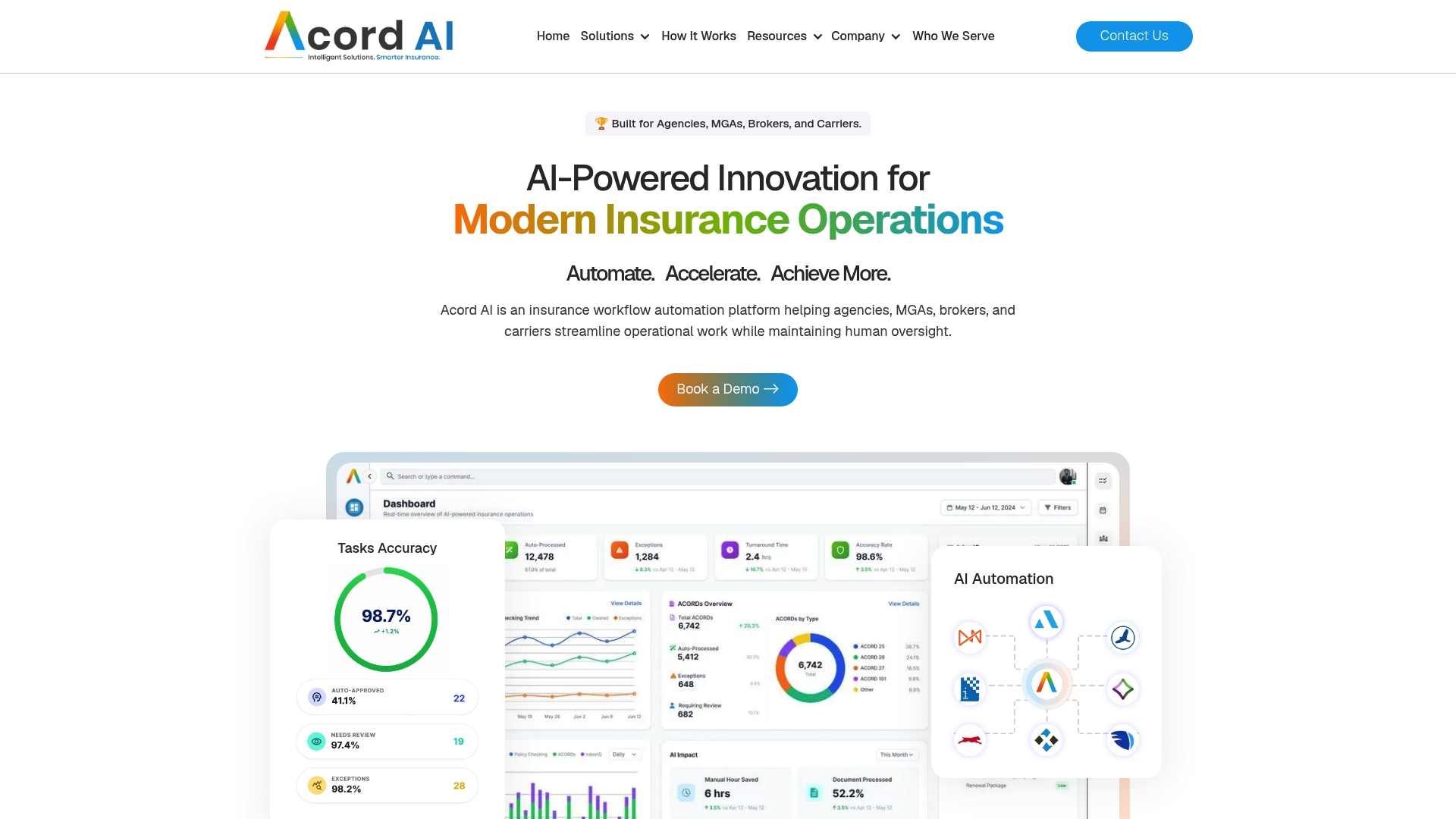
Acord AI is licensed as a subscription to agencies, MGAs, brokers and carriers, and access starts with a demo on acordai.ai.
COI stands for certificate of insurance. It is a document issued by an insurer, agent or broker that provides evidence a policy is in force and summarizes key policy details. It is commonly requested before a project begins or a vendor comes on site.
It depends on the request. A simple certificate based on policy information can be issued quickly, while requests naming a holder or seeking additional insured status need more information. One Ontario association’s published process states up to two business days.
Include the named insured’s full name and address, the certificate holder, a specific required-by date, the work or service details, the contract or agreement number, the required liability limits and the contract’s insurance requirements. MEARIE’s guide also notes that only one holder can be listed per certificate.
Receive it in one monitored channel, confirm the details are complete, triage it as routine or requiring review, check each item against the policy and endorsements, issue the certificate, and file the request with the certificate sent. Requests beyond existing coverage need clarification or a policy change first.
The reading, matching, drafting and filing steps can be. Decisions on additional insured status, special wording and coverage beyond the policy stay with a person. Acord AI’s platform is built on this split, with human review kept in the workflow.


One Platform. Smarter Insurance Operations. Start Your Journey Today.