Insurance Knowledge Management for Canadian Agencies and Carriers
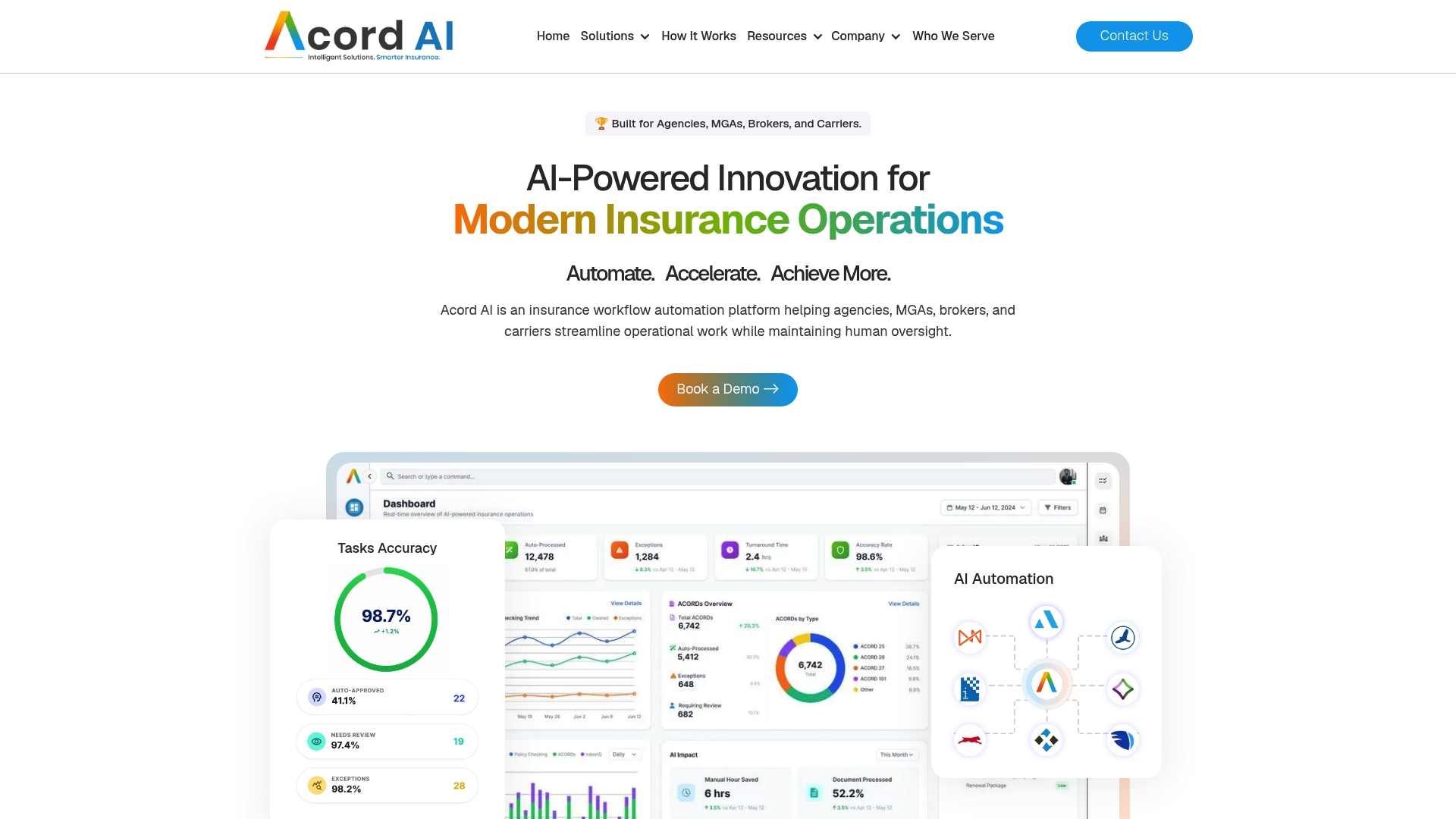
An insurance agent copilot is software that takes on the reading, extraction, comparison and drafting that fill an agency’s day, while a licensed professional keeps every decision. For agencies, MGAs, brokers and carriers, the value is a workflow in which each task is prepared by automation and approved by a person. A general-purpose chatbot does not give you that. Acord AI is built on this model: policy checking, quoting, ACORD form preparation and certificate requests are automated, with human oversight on the output.
Deloitte Canada describes AI copilots as tools that help advisors, brokers and service representatives prepare recommendations, synthesize customer information, document interactions and reduce administrative work, while people keep ownership of the customer relationship. That description is the practical test of any product using the name.
The term covers a range. At one end is a chat assistant that answers questions about coverage wording or procedures. At the other is a set of workflow tools that watch an inbox, pull data from attachments, compare a renewal against an expiring policy and fill in a form. Most agencies need both: an assistant for knowledge, and automation for the repetitive document work that consumes service and placement time.
The common thread is the division of labour. The software handles volume and consistency. The broker or agent handles judgment, advice and the client conversation.
Insurance work is document-heavy: applications, declarations pages, endorsements, loss runs, certificates, carrier correspondence. A document assistant is the part of a copilot that turns those files into structured, checkable data.
The Insurance Brokers Association of Canada (IBAC) tested this pattern in a proof of concept for personal lines, described in Deloitte Canada’s overview of point-of-need distribution. The agent collects client information, processes renewal documents from selected carriers, extracts key data and validates it. Missing or low-confidence fields trigger clarification prompts. Validated data then goes into the broker management system, which generates quotes, and every interaction is logged for a compliance audit trail.
That sequence shows what to expect from any document assistant:
The flagging step matters most. An assistant that surfaces discrepancies between a policy and its source documents saves more review time than one that simply produces fluent text.
A Canadian commercial brokerage described in its own published material a set of AI agents covering certificate production, binder preparation, proposal drafts, market submission packaging, quote and renewal comparison, policy audits and risk summaries. The list is a useful map of where agency time goes. For agencies, MGAs, brokers and carriers, the work falls into a few families.
Service requests arrive by email in every format. Sorting, classifying and routing them is repetitive work that benefits from automation. Inbox IQ handles automated email and request management in the Acord AI platform, and the Inbox IQ workflow guide explains how it is set up.
Checking a policy against a quote, binder or expiring contract means reading line by line for discrepancies in coverage, limits and endorsements. Policy IQ is designed for policy checking and comparison, with exceptions identified for a person to review.
The same client data is typed into ACORD forms again and again. Forms IQ prepares ACORD forms from the information already in the file, and AI-assisted ACORD form preparation leaves the final review to your team.
Quoting speed is where brokers feel competition most directly. Quotes IQ supports quoting and remarketing. For a wider view of the process, read our guide to insurance quote automation for Canadian agencies.
Certificate requests are high-volume and low-variation, which suits automation well. Cert IQ handles certificate request workflows, and the Cert IQ workflow guide covers the details.
Producers and service staff constantly look up how a coverage works or what a procedure requires. Ask AIVA is the insurance knowledge assistant in the platform, covered in the Ask AIVA workflow guide.
For MGAs, which handle submissions and endorsements across many carriers, the question of what to automate and what to review is covered in our MGA workflow automation guide.
Efficiency claims in this field range from careful to inflated, so it helps to know what has been measured and by whom.
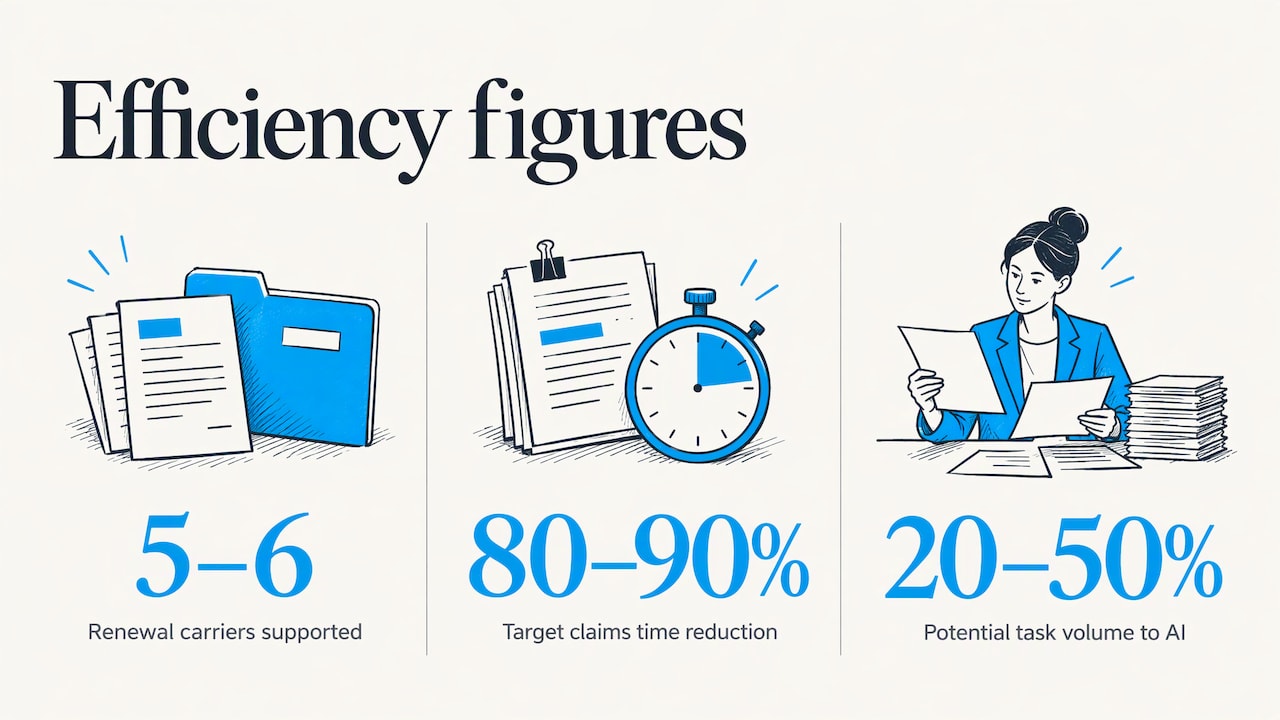
IBAC’s AI Working Group ran two proofs of concept: a personal lines onboarding agent that processes renewal documents from five to six carriers and integrates with the broker management system, and a commercial lines tool for coverage discovery and gap analysis. The preliminary results in SaskBroker reported that the tools were easy to use and delivered significant time savings, with benefits for accuracy, workflow efficiency and client satisfaction. The point for brokers is capacity: time released from administration goes to client engagement.
Deloitte Canada’s analysis of AI orchestration in insurance gives a carrier-side view. For claims processing, a connected set of eligibility, extraction, classification and routing agents targets document processing time reductions of 80 to 90 percent. Deloitte attributes those gains to the connection and shared data foundations between the components rather than to any single component. Its role analysis also finds potential to shift 20 to 50 percent of task volume to AI execution, with supervisory and judgment-intensive work staying with people.
Two practical lessons follow. First, gains come from connected workflows, so a tool that sits outside your email, forms and management system saves less than one that connects to them. Second, the work that remains with people is the part clients value most, which is why review is designed into the process rather than treated as an afterthought.
In Canada, the governing principle is consistent: AI changes how work is prepared, not who is accountable.
RIBO’s guidance, Responsible AI Use Among RIBO Licensees (May 2025), states that a broker’s Code of Conduct and Fair Treatment of Customers obligations do not change when AI is used, and that AI does not replace professional judgment. Anything generated or altered by an AI tool must be overseen by a licensed member before it is presented to a client. The guidance also covers disclosure to customers who engage with AI, vetting vendors so client data does not leave the firm’s control or get used for training, and avoiding open AI systems for client information. It asks firms to build an AI governance policy before introducing tools and to train brokers to recognize when AI is used.
In practice, that gives a short checklist for safe use:
RIBO’s consultation responses from November 2025 to March 2026 point the same way. Respondents stressed that accountability remains with licensed individuals, that AI outputs are inputs to broker decisions, and that audit trails documenting logic and data sources are needed. RIBO said it will consider further guidance on minimum human-review expectations, disclosure, vendor oversight and data governance, so check its site for updates.
Lloyd’s Canada’s guidance for coverholders expects governance controls before an AI system or document-generation tool is deployed or materially changed in connection with Lloyd’s business. These include documented human accountability, testing and validation, bias monitoring, and limits on using confidential or personal information for model training. AI tools must not make final decisions to decline, cancel or materially alter coverage without human review where required, and the coverholder remains responsible for how its technology providers handle data.
OSFI published final Guideline E-23 on model risk management on September 11, 2025. It takes effect May 1, 2027 for all federally regulated financial institutions, including property and casualty companies. Only models that carry risk to the institution are inventoried and subject to full lifecycle governance, and OSFI says low-risk generative AI uses such as document summarization can be rated accordingly. Third-party models receive validation and monitoring in proportion to their risk. Carriers evaluating a platform now should plan for this timeline.
The Casualty Actuarial Society’s AI Primer offers a sound sequence, although it is written for actuaries. It recommends codifying a single workflow with rules, escalation thresholds and output templates, and validating it against prior periods before moving to broader infrastructure. It adds that projects lacking standardized data, a scripted methodology, an approved enterprise model endpoint and IT engagement consistently underdeliver.
For an agency, that translates into five steps.
Our article on document review automation for insurance teams in Canada goes deeper on the review step. Teams exploring broader applications of AI agents for business workflows across email and CRM channels will find the same principle: define the process first, then automate it.
Deloitte Canada’s six-question assessment is a workable buying framework. Adapted for an agency or carrier, it asks:
Deloitte also argues that the binding constraint is workforce willingness to work with AI as a partner, and that under OSFI E-23 explaining how an AI-driven decision was made is a compliance requirement. Governance and change management belong in the design from the start.
A useful additional filter is fit with the way your team already works. Look for a platform that covers your actual task list (email, policy checks, forms, quotes, certificates, knowledge questions), lets you configure the workflow, and keeps a person in the approval seat.
What we believe about copilots
Most agency time is not spent on advice. It is spent reading documents, rekeying data and checking one set of figures against another. That is the work automation should take, and it is the work we built Acord AI around: policy checking, quoting, ACORD form preparation, certificate requests and email management.
We design the platform so that automation prepares and people decide. Human review is part of the workflow, not an optional extra, because accuracy and accountability are what clients and regulators expect from a licensed professional.
Workflows should also be configurable. No two agencies, MGAs or carriers handle an endorsement or a renewal in the same way, so the platform should adapt to the team rather than the reverse.
the author
Acord AI is an insurance workflow automation platform for agencies, MGAs, brokers and carriers. Its solutions are Inbox IQ for email and requests, Policy IQ for policy checking and comparison, Forms IQ for ACORD forms, Quotes IQ for quoting and remarketing, Cert IQ for certificate requests and Ask AIVA as an insurance knowledge assistant. Human review stays in the process, and the platform integrates with industry systems. Pricing is not published, and access follows a demo. See the full set of solutions or visit Acord AI to request one.
No. A chatbot answers questions in a conversation. A copilot takes part in the workflow: it reads documents, prepares forms and comparisons, flags exceptions and hands the result to a person for approval. A knowledge assistant such as Ask AIVA is one part of that wider set of tools.
It should not. It extracts, compares and flags, and a licensed person decides. RIBO guidance says AI does not replace professional judgment, and Lloyd’s Canada expects human review before AI-influenced decisions to decline, cancel or materially alter coverage. Acord AI keeps human review in its workflows for this reason.
Choose one with clear inputs and outputs and a high volume of repeats, such as certificate requests, renewal comparison or ACORD form preparation. Write down the rules and exception thresholds, check results against completed files, and then add the next workflow.
Yes, under existing professional obligations. RIBO frames AI use as governed by the Code of Conduct and fair treatment duties, and asks firms to adopt an AI governance policy and keep a licensed member overseeing AI output. Carriers should also note OSFI Guideline E-23, effective May 1, 2027.
Both benefit, but the largest gains come when it is deployed across a team’s shared workflows. Agencies, MGAs, brokers and carriers each use it differently: producers for quotes, service teams for requests and certificates, and carriers for connected processing.


One Platform. Smarter Insurance Operations. Start Your Journey Today.