How to Handle COI Requests Faster Without Losing Accuracy
Document review automation for insurance means software reads the documents your team handles every day, such as policies, quotes, ACORD forms and certificate requests. It extracts the relevant data, compares it against source documents and flags discrepancies for a person to resolve. For Canadian agencies, MGAs, brokers and carriers, the strongest approach pairs that automation with human review at every decision point. Acord AI is built on this principle: an insurance workflow automation platform where review work is automated and people keep the final say.
In most insurance offices, “review” is a long list of small, repeated tasks. Someone opens a policy PDF and checks it against the quote or the expiring policy. Someone reads an email, finds the attachment, and decides what the request is. Someone copies applicant details into an ACORD form (the standardized forms used across the industry to submit risk information to carriers). Each task is simple. Together they consume the day.
Automation changes who does the first pass. Software ingests the document, identifies its type, pulls out the fields that matter (named insured, limits, deductibles, endorsements, effective dates), and compares them with a reference such as a quote, a prior term or a client’s request. Where something does not match or is missing, the system raises an exception. A person then reviews the exceptions instead of reading every page.
This differs from generic document management. A filing system stores and retrieves documents. Document review automation reads them and produces a result: a comparison, a completed form, a list of discrepancies or a drafted response.
Research on Canadian practice is thin. RIBO’s July 2024 report on AI in property and casualty insurance found very little published research on AI use among Canadian insurance brokers. Interviews suggested current use centres on process automation for routine tasks, including renewals and scanning insurance manuals, with people reviewing outputs. That is the practical starting point: routine, rules-based review with a human check.
The tasks that fit this pattern best are listed below, with the Acord AI solution built for each.
| Document or task | What automation does | Acord AI solution |
|---|---|---|
| Inbound email and attachments | Triages requests, identifies what is being asked, and routes the work | Inbox IQ |
| Policies and endorsements | Checks and compares policy documents, identifies exceptions | Policy IQ |
| ACORD forms | Prepares forms from source documents | Forms IQ |
| Quote submissions and remarketing | Supports quoting and remarketing across carriers | Quotes IQ |
| Certificate requests | Handles certificate requests | Cert IQ |
| Coverage and product questions | Answers from an insurance knowledge base | Ask AIVA |
Each solution is described on the Acord AI solutions page.
Policy checking is the clearest case for automation because the task is comparison. A reviewer needs to confirm that the issued policy matches what was quoted and bound: the right limits, the right endorsements, the correct named insureds and no unexpected exclusions. Doing this by eye across dozens of pages invites missed discrepancies, especially at renewal volume.
Policy IQ automates the comparison and identifies exceptions so that reviewers spend their time on the items that differ. For a deeper look at how coverage is evaluated once the data is extracted, see our guide to insurance coverage analysis for Canadian brokers.
For many agencies, the inbox is the real front door. Requests for changes, certificates, quotes and renewals arrive as free-form messages with attachments. Reading and classifying them is review work in its own right. Inbox IQ provides automated email and request management, so that the right request reaches the right person with its documents attached.
ACORD form preparation is mostly transcription: the same applicant data, entered again for each carrier. Automating it from source documents reduces keying errors and frees producers and account managers for client work. Quoting follows the same logic, since a clean, complete submission is the precondition for fast quotes. Our guide to insurance quote automation for Canadian agencies covers how this connects to remarketing.
Automation delivers little if it sits beside the workflow rather than inside it. Documents arrive, get reviewed, feed a quote or a policy change, and end in the agency management system or a carrier portal. A review tool that cannot pass its results onward leaves staff re-entering data, which defeats the purpose.
Three design points matter.
A typical sequence looks like this: a request arrives by email, is classified and routed, source documents are analyzed, a form or comparison is prepared, exceptions are surfaced, and a licensed team member approves before anything goes to a client or carrier.
Canadian insurance has considerable room to gain from moving off manual handling. The Insurance Council of British Columbia’s June 2024 State of InsurTech Report, drawing on 598 survey responses and interviews with 22 organizations, found that 86% of companies still use paper documentation for claims information intake. It also found that only 54% of adjusters use any technology to process information and only 4% fully automate claims assessment in most cases. That report concerns claims, but the same pattern of paper and manual handling applies to the documents that come before a claim.
Older evidence points the same way. A peer-reviewed case study of the Workers’ Compensation Board of British Columbia’s electronic claim file found that 91% of 1,200 surveyed staff rated the electronic document system better than paper-based processes. Average time to payment on accepted claims fell from 28 days in the 1990s to 20 days or less after implementation. The setting is a public compensation board, and the technology is far older than today’s tools, but it shows that handling documents electronically changes cycle times and staff experience.
An illustration of the arithmetic, using hypothetical numbers: if a renewal policy check takes a reviewer 25 minutes and your office handles 40 renewals a week, that is nearly 17 hours of comparison work weekly. If automation produces the comparison and the reviewer only examines flagged exceptions, the time shifts from reading to deciding. Your own figures will differ, so measure your baseline before you begin.

Automated review is a first pass, and Canadian regulators are explicit that people remain accountable.
RIBO’s Responsible AI guidance, published on May 29, 2025, says brokerages should have one or more licensed brokers closely monitor generative AI use, keeping a “human in the loop”. That lets licensed members respond to coverage questions and correct incorrect or misleading results. The same guidance advises licensees to avoid processing client information through open AI systems.
The Insurance Council of British Columbia frames automation as a spectrum: complex claims need more human review, while simple ones may be automated in triage. The same logic applies to document review. Routine matching can be automated broadly. Judgments about whether a coverage gap is acceptable for a particular client, or how to explain a change, belong to a licensed professional.
For carriers and MGAs working under Lloyd’s authority, the guidance is firmer still. Lloyd’s Canada guidance for coverholders calls for documented human accountability, testing and validation, monitoring for accuracy and unintended bias, and escalation, override and audit procedures. It also states that AI tools must not make final adverse decisions, such as declining, canceling, non-renewing or materially altering coverage, without appropriate human review.
A platform designed around human oversight lets you meet those expectations as a matter of normal operation: every output has a reviewer, and exceptions are visible.
RIBO’s July 2024 report cautions that AI applications may be trained on biased or inaccurate data and may gather personal data without informed consent, and that cybersecurity risk can be high unless intermediaries understand what data is collected and why. Use the following list when you evaluate any review automation.
RIBO recommends vetting vendors to confirm that customer data processed through AI tools does not leave the firm’s control, is not stored by the vendor and is not used for training. It also recommends written policies on authorized and unauthorized AI use. Lloyd’s Canada guidance adds that collection, use, disclosure, retention, hosting, transfer and disposal of personal information must comply with applicable federal and provincial privacy laws, supported by consent mechanisms, breach response protocols, vendor controls and records of processing. Acord AI publishes its approach on its security and privacy page, which is the place to start your internal review.
Confirm how the system flags uncertainty and discrepancies, and who sees them. Ask for outputs that point back to the source document, so a reviewer can verify any extracted field in seconds. Decide in advance which exception types require senior review.
You should be able to reconstruct who reviewed what, when, and what changed. This supports both E&O protection and the documented accountability that regulators describe.
List the systems the reviewed data must reach: agency management system, rating tools, carrier portals. RIBO’s report lists dated technology systems as a barrier to adoption, along with high upfront costs for smaller operations and limited AI expertise. Mapping integration needs early keeps the scope realistic.
Market conduct rules in Canada fall primarily to provincial regulators, coordinated nationally through CCIR, while federal legislation for insurers focuses on solvency. Check the requirements of the regulator in each province where you hold licenses.
Most of the insurance workday is reading, comparing and re-keying. None of it is where an agency’s expertise adds value, yet it consumes the hours that expertise needs.
We built Acord AI to take the first pass on that work: policy checking, ACORD form preparation, quoting support, certificate requests and inbox triage. We pair that with human oversight and configurable workflows, because accuracy in insurance depends on a qualified person confirming the result.
Document review automation succeeds when it fits the way your team already operates and connects with the systems you use. That is why we integrate with key industry systems and let each agency, MGA, brokerage or carrier shape the workflow to its own rules.
the author
Acord AI brings these review tasks into one platform, with a separate solution for each: Inbox IQ for email and requests, Policy IQ for policy checking, Forms IQ for ACORD forms, Quotes IQ for quoting and remarketing, Cert IQ for certificates and Ask AIVA as an insurance knowledge assistant. Access is by subscription after a demo. You can see all six on the solutions page.
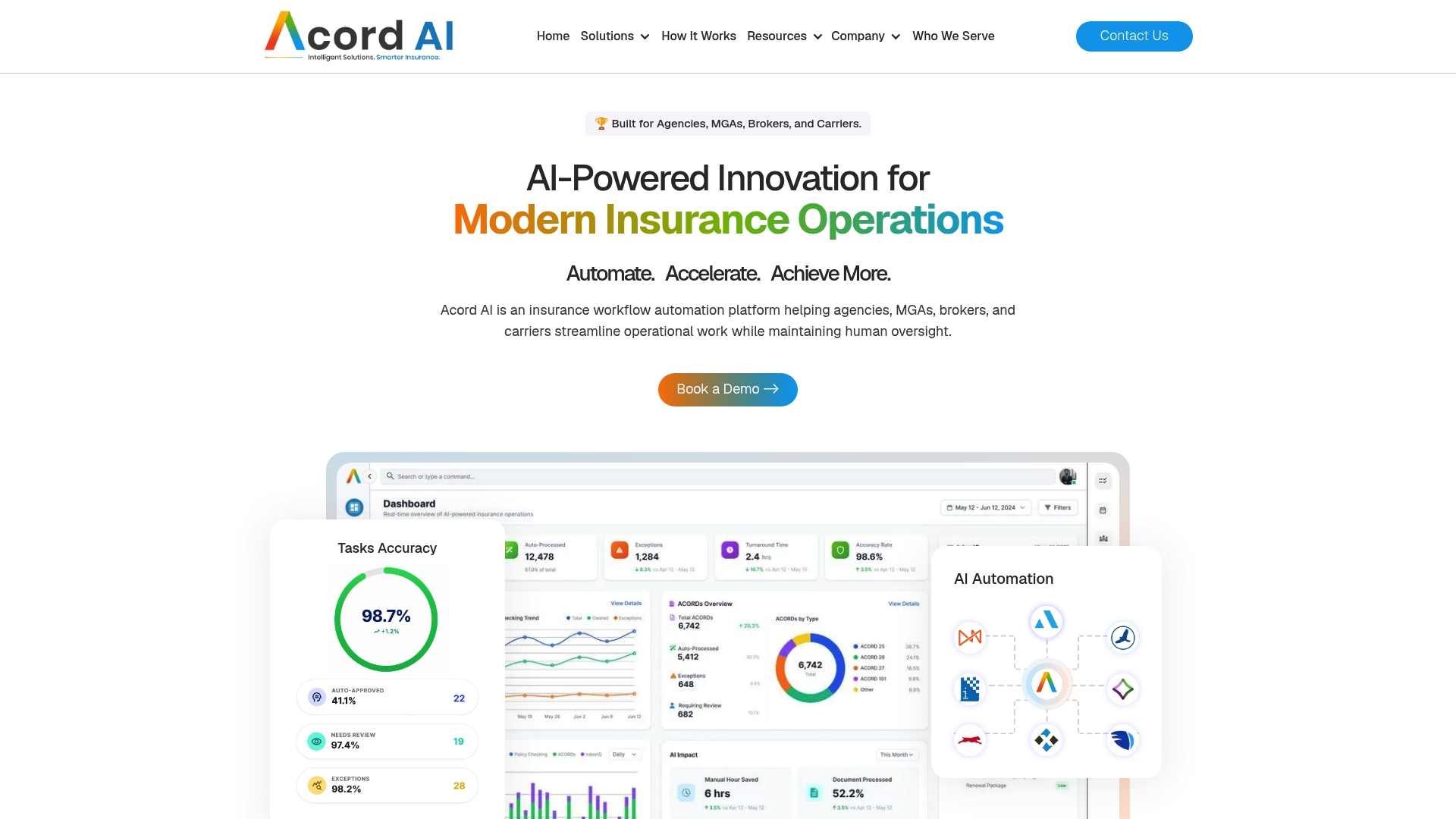
If you want to start with the highest-volume task in your office, the workflow guides for Policy IQ and Inbox IQ show how each is set up.
No. It prepares the work and surfaces exceptions, and licensed staff make the decisions. RIBO’s 2025 guidance expects licensed brokers to monitor AI output and keep a human in the loop. Acord AI is designed with human review for decision-making.
Start with high-volume, rules-based comparison: policy checking at renewal, certificate requests, or ACORD form preparation. These have clear source documents and clear exceptions, so results are easy to verify and the time saved is easy to measure.
Privacy compliance depends on how data is collected, stored, used and transferred, and on your vendor controls. Regulators such as RIBO recommend confirming that client data stays under your control and is not used to train models. Review the vendor’s security and privacy documentation against your own policies and provincial requirements.
Acord AI integrates with key industry systems and supports configurable workflows. Map the systems your reviewed data must reach before implementation, and use that list to scope the setup.


One Platform. Smarter Insurance Operations. Start Your Journey Today.