How to Handle COI Requests Faster Without Losing Accuracy
Insurance API integration connects the systems an agency, MGA, broker or carrier already uses, so that data entered once moves to the next system without re-keying. In Canada, the practical route is to build on the standards published by CSIO, the industry technology association, and to pair the connection with a workflow layer that handles the documents, emails and exceptions that APIs do not reach. Acord AI automates those document-heavy steps, including policy checking, quoting support and ACORD form preparation, with human review at the decision points.
This guide explains what an insurance API is, how it differs from broader data integration, what the Canadian standards cover, how to plan and maintain an integration, and which security questions to settle first.
An API (application programming interface) is a defined way for one software system to request data from another or send it to it. In insurance, it is the mechanism that lets a broker management system (BMS) talk to an insurer’s policy, billing or claims system.
CSIO’s 2023 Annual Report states that APIs enable broker management systems and insurer systems to share information quickly and easily. Without them, brokers have to log into the insurer’s portal or contact the company by email or telephone to complete customer transactions. The same report notes that JSON, a compact data format, allows condensed data sets to move between insurer and broker systems in real time.
The practical meaning for an agency is simple. A request that once required a portal login, a phone call or a PDF attachment becomes a structured message between two systems. The data arrives in a predictable format, so the receiving system can use it without a person interpreting it.
IBAC’s D/X materials describe the current pattern in the Canadian property and casualty (P&C) industry: the broker enters data into the BMS, then re-keys it into the carrier portal. That introduces delays and data quality issues that need costly manual intervention, and the same materials say real-time data transmission is still in its infancy in P&C.
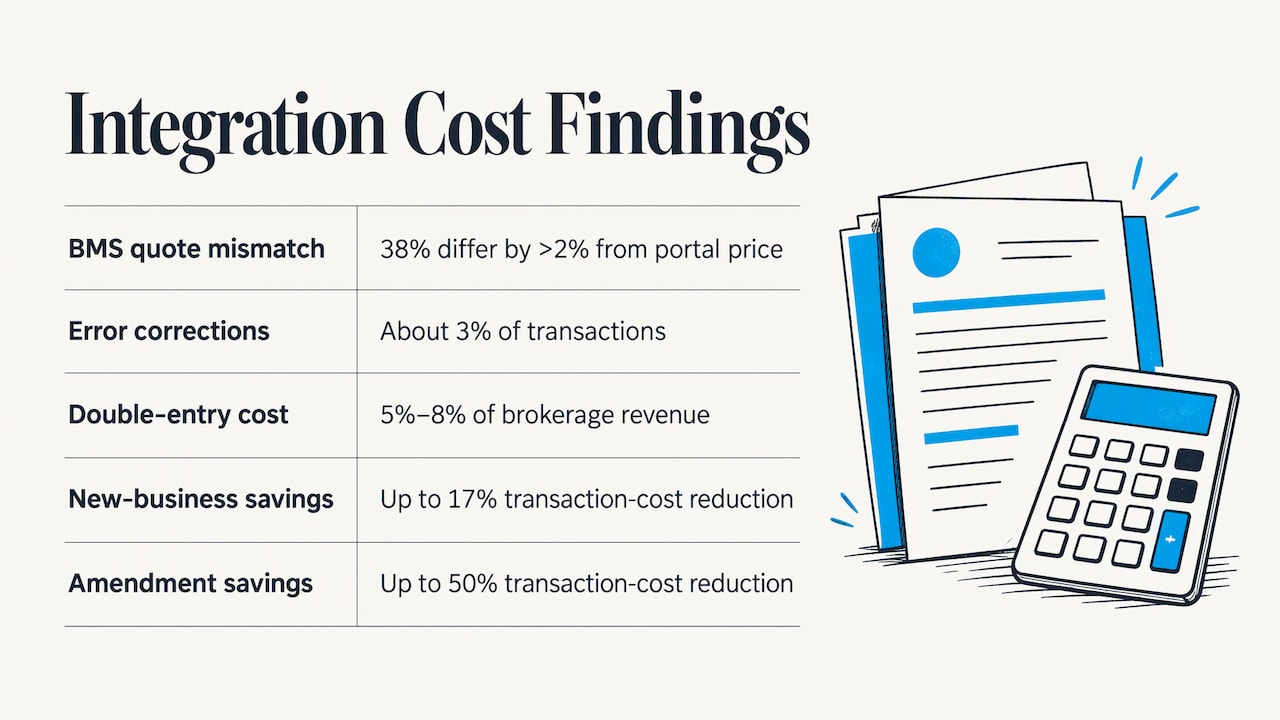
The cost is measurable. A 2022 study commissioned by IBAC and conducted by Online Business Systems, as reported in IBACtech’s February 2026 analysis, found that about 38% of quotes generated in a BMS differ by more than 2% from the final carrier portal price, and roughly 3% of transactions need correction because of human error. It also reported that double entry can cost brokerages 5% to 8% of total revenue, and that a standardized API model could reduce transaction costs by up to 17% for new business and up to 50% for policy amendments. These are study findings for the Canadian broker channel, not guarantees for any single office.
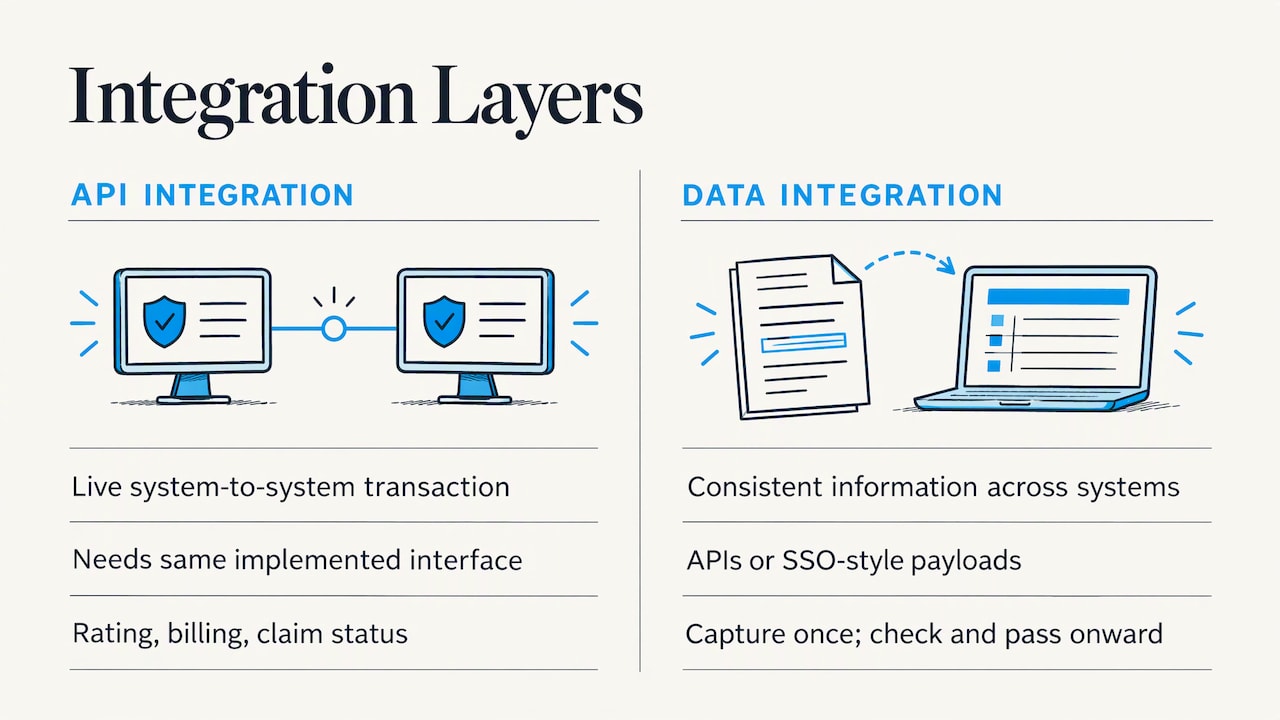
Searchers use “API integration”, “data integration” and “data integration software” almost interchangeably, but they describe different layers.
API integration is a live, system-to-system connection for a specific transaction, such as requesting a rating, retrieving a billing schedule or checking claim status. It is the right tool when both sides have implemented the same interface.
Data integration is the wider goal of getting consistent, accurate information into every system that needs it. APIs are one method. IBAC’s 2023 Brokercore vendor document describes API connectivity for rating and real-time third-party data lookups, and also describes SSO-style data payloads that send or receive client data to pre-populate forms or start workflows when an API is difficult to implement. That alternative still minimizes double entry and improves data accuracy.
For an operations leader, the distinction decides where to invest. If a carrier exposes a standard API for the transaction, use it. If it does not, the work is still data integration: capturing the information from the source document or email once, checking it, and passing it onward without retyping.
Much of daily agency work does not arrive as a structured message. Policies, endorsements, certificate requests, loss runs and client emails arrive as PDFs and free text. An API cannot read a renewal policy and flag that a named insured differs from the application. That requires document analysis and exception identification, which is the ground that workflow automation covers, and it is where most agencies lose time even after their core systems are connected.
Canadian P&C integration is shaped by CSIO, which describes itself as the industry technology association of P&C insurers, vendors and more than 38,000 brokers. According to its 2023 Annual Report, its XML Standard is licensed to CSIO by ACORD, the global insurance data standards body, so the Canadian and international standards share a lineage.
On September 18, 2023, CSIO’s API Implementation Working Groups published a JSON API Implementation Guide and finalized standards for four more use cases: addition of coverage on risk, get claims status, amend payment details, and amend address of a financial institution. That brought the JSON API Standards to 20 technical schemas covering the majority of brokers’ daily business activities. The Guide helps vendors program the standards into their systems and aims to improve message workflows and data synchronization between vendor and insurer applications.
The same release quotes Gaurav Chhabra, Lead Architect at Travelers Canada, who said that finalizing the Guide improves messaging and enables data synchronization so brokers receive information quicker.
The standards pipeline is large. The 2023 Annual Report states that the INNOTECH Advisory Committee and the API Implementation Working Groups completed business requirements for an additional 165 use cases in 2023. These span personal lines auto, personal lines habitational, Individually Rated Commercial Automobile (IRCA) and Commercial General Liability (CGL), and include policy cancellation, first notice of loss creation, addition or deletion of coverage, and addition of a vehicle or driver.
IBACtech’s analysis frames the CSIO API gateway as a response to the fragmented many-to-many integration landscape, where each broker system would otherwise need a custom connection to each insurer. The gateway is described as neutral, CSIO-hosted middleware that translates different data formats into a single standardized stream, giving the industry a secure point of entry that protects data integrity and confidentiality.
The approach below applies to an agency, MGA, brokerage or carrier. It starts with the work, not the technology.
List the transactions your team performs each week: new business quotes, endorsements, certificate requests, renewals, claims notices. For each, record where data originates, how many systems it passes through, and how often it is re-keyed. The 2022 study figures above give a reference point for what re-keying can cost, but your own error and rework counts decide your priorities.
For each transaction, ask whether the other party exposes a standard interface. Structured transactions such as claim status or billing schedule retrieval are API candidates. Work that begins with a policy PDF, an ACORD form or an email is a document workflow. Most offices have both, and treating them as one project is a common reason integrations stall.
IBAC’s D/X materials argue that real-time connectivity in the broker channel will not arrive all at once. They describe an incremental effort and encourage brokers to use transactions their vendor and carrier partners have already implemented, while carriers and vendors keep investing because the benefits reach customers, brokers and carriers alike. The practical conclusion is to ask your BMS vendor and your top carriers which standard transactions are live, and begin with those.
The pace of adoption is visible in certification. In January 2026, CSIO announced that a Canadian vendor had achieved its JSON API Standards and API Security Standards certifications, implementing five use cases including First Notice of Loss and Get Payment Status. The annual report had flagged a JSON API Standards Certification program as a 2024 goal, so certified implementations are now a real signal when you assess a vendor.
While API coverage grows, the documents still need to be handled. This is the step where Acord AI fits: its Policy IQ checks and compares policies, Forms IQ prepares ACORD forms, Quotes IQ supports quoting and remarketing, Inbox IQ manages emails and requests, and Cert IQ handles certificate requests. The platform integrates with industry systems and keeps human review in place for decisions, so staff confirm exceptions rather than retyping data.
An integration is a running service. Name an owner for each connection, define what counts as a failed message, and decide who reviews exceptions. CSIO’s standards evolve as use cases are added, so schedule a periodic review of which transactions your systems support against what the standards now offer.
Return to the figures from Step 1 after rollout: re-keying events per week, correction rate, time from request to response. Report the change against your own baseline, not against a published average.
An integration widens the number of systems that touch client data, so security belongs in the first design meeting, not the last.
CSIO’s API Security Standards, described in its 2023 Annual Report, address data confidentiality, API endpoint security, security logging and monitoring, security testing, identity, authentication, and authorization access control. They are based on OWASP API Top 10 best practices and address OAuth 2.1. For teams that want a broader view of how API protections work in practice, this overview of API security requirements is a useful companion to the standards.
Regulatory alignment matters too. IBACtech reports that the AI principles in the industry data-exchange initiative will align with international AI guidelines (ISO 42001 and OECD frameworks) and with industry-specific regulations including RIBO, OSFI and AMF. If your organization operates in Ontario, federally regulated insurance or Quebec, confirm with your compliance officer which of these bodies applies to your integration and AI use.
Acord AI’s security and privacy page sets out how the platform approaches responsible use of insurance data.
When comparing insurance data integration software, whether from a BMS vendor, a middleware provider or a workflow platform, use criteria tied to the work you mapped in the planning steps.
| Criterion | What to ask |
|---|---|
| Standards support | Which CSIO JSON API use cases are implemented, and is the vendor certified? |
| Security | Does it follow CSIO’s API Security Standards and OWASP API Top 10 practices? |
| Document handling | Can it read policies, forms and emails, not only structured messages? |
| Exception handling | How are mismatches flagged and routed to a person? |
| Configurability | Can workflows be adjusted to your office’s process without custom development? |
| System connections | Which industry systems does it connect with? |
| Human oversight | Where does a person review and approve before anything is issued? |
A platform that covers only structured messages leaves the document backlog untouched. One that covers only documents leaves re-keying between systems in place. Most agencies need both layers working together.
Insurance teams rarely struggle because a system is missing. They struggle because information has to be carried by hand between systems, and because the documents that drive the work, policies, endorsements, forms and emails, do not arrive in a structured format.
We build Acord AI around that reality. APIs and standards are the right foundation for structured transactions, and we integrate with industry systems so the platform works alongside the tools an office already runs. Our workflows then take on the repetitive document work: policy checking and comparison, ACORD form preparation, quoting and remarketing support, email and request management, and certificate requests.
We keep human review in every workflow. Automation prepares, compares and flags; the insurance professional decides. That is how a team reduces manual workload while maintaining the accuracy that clients and carriers expect, and it is why configurable workflows matter more than a fixed process imposed on every office.
the author
After the API connections are in place, the remaining manual effort sits in inboxes, policy PDFs and forms. Acord AI is a subscription platform for agencies, MGAs, brokers and carriers that automates that work, from policy checking in Policy IQ to quoting support in Quotes IQ, with configurable workflows and human review. Pricing is not published; access follows a demo. See the full set of Acord AI solutions to match a tool to your busiest transaction.
Teams ready to see how this fits their systems can start from the Acord AI home page.
It is a direct connection between two software systems, such as a broker management system and an insurer’s platform, that lets them exchange data for a defined transaction. CSIO’s 2023 Annual Report says this removes the need to log into a portal or phone the insurer to complete a transaction.
API integration is one method of moving data live between systems. Data integration is the broader goal of getting accurate data into every system without re-keying. It can also use data payloads that pre-populate forms, and document automation that captures information from source files.
CSIO publishes JSON API Standards, which cover 20 technical schemas, and API Security Standards based on OWASP API Top 10 practices. Your BMS vendor and carriers can tell you which use cases they have implemented.
Not necessarily. A practical start is to use transactions your vendors and carriers already support, and to add workflow automation for documents and emails. Acord AI integrates with industry systems and offers configurable workflows, so teams can adapt processes without building their own connections.
Start with a list of weekly transactions and the number of times each is re-keyed. Pick the highest-volume transaction, confirm whether a standard interface exists for it, and automate the document steps around it.


One Platform. Smarter Insurance Operations. Start Your Journey Today.