How to Handle COI Requests Faster Without Losing Accuracy

Most delay in insurance application processing starts at intake, not at underwriting. Incomplete answers, illegible documents, mismatched details and requests buried in shared inboxes create rework before a risk is ever assessed. Agencies, MGAs, brokers and carriers shorten the cycle by checking applications for completeness at the point of entry, preparing forms from source documents, routing exceptions to a person and keeping a human reviewer on every decision. Acord AI is built around that sequence: automation handles the repetitive preparation and checking, and your team keeps the judgment.
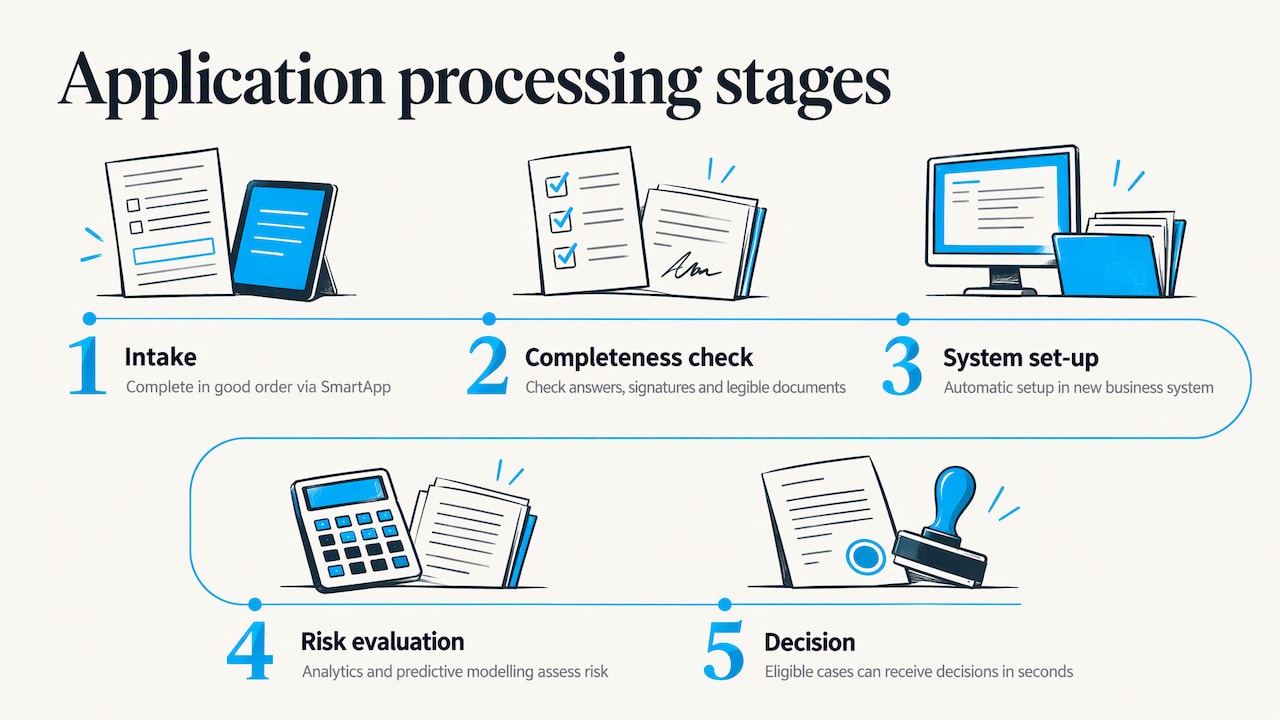
An application passes through a short sequence of stages: intake, completeness check, data entry or system set-up, underwriting or quoting, and a decision. Each stage can add days if the one before it was not done cleanly.
BMO’s description of its digital process for life and critical illness cases shows the ideal path. The application is completed in good order through its SmartApp eApplication, which sets up the case in the new business system automatically. Risk evaluation then runs on analytics and predictive modelling, and eligible applications can receive an underwriting decision within seconds. Its Accelerated Underwriting handles qualifying clients up to $5,000,000 without further medical testing (BMO Canada, August 2026).
Those results depend on one condition: the application is complete and correct when it enters the system. “Good order” means every required question is answered, signatures and documents are present and legible, and nothing conflicts. Applications that fail the test do not move. Empire Life’s reference guide says incomplete, conflicting or illegible instructions are deemed not in good order and cannot be processed.
For an agency, MGA or brokerage, the same logic applies one step earlier. Before a submission reaches a carrier, your team receives emails, collects documents, prepares forms and builds quote requests. If that preparation is manual, the errors enter there.
There is no single processing time. It depends on the product, the amount of coverage and the scrutiny applied.
The pattern is consistent. Machine-speed decisions are available when data is clean, and delay accumulates when it is not. Time spent waiting on a third party, such as a physician, sits outside the application workflow. Time spent correcting your own intake sits inside it, and that is the part a team can control.
Manulife’s published analysis of its 2013 life and critical illness business remains one of the clearest Canadian measurements of intake error. It found that almost 61% of paper applications had unanswered questions. Those gaps produced 8,757 contract amendments, almost 15% of contracts issued, and 29,600 requests for information. On average, unanswered questions or missing information delayed a case by four calendar days.
The errors were concentrated. Family history question 7.2.b was missed on 6,552 applications, and 762 amendments were generated for question 5.3.c on alcohol or drug treatment. Manulife also reports that its not in good order rate for new business applications is close to 30%, and higher for policy change applications.
Two lessons follow for any intermediary:
These figures describe life and critical illness paper applications from 2013. The principle carries over to commercial and personal lines, where submissions combine forms, loss runs, schedules, prior policies and emails, and where a missing detail has the same effect.
Signature and document requirements are a frequent cause of returned files, and they vary by product and carrier.
Empire Life’s guide requires the owner or beneficial owner, each joint owner, the annuitant if different from the owner, and the advisor to sign new applications. Corporations may sign through two officers with titles, one officer with the company seal, or a sole signing officer with a binding-authority statement.
Humania requires the representative to sign in the identification section, attach the initial premium where required and submit a legible illustration for each product and policy. Applications that fail these requirements are returned unprocessed. E-mailed documents must be complete, legible, in PDF format and one document per file.
For mortgage insurance, Sagen expects lenders to retain documents such as a signed mortgage loan application, the solicitor’s final report, evidence of marketable title or title insurance, and identity verification.
A practical intake checklist therefore records, per carrier and product, who must sign, which attachments are mandatory and which file formats are accepted. Keeping that checklist in a configurable workflow, rather than in individual memory, is what makes it reliable across a team.

Application handling combines repetitive preparation with judgment. The two should be separated deliberately.
Well suited to automation
Kept with people
The boundary matters because automation without review moves errors faster. A workflow where the software prepares and flags, and a licensed professional confirms, keeps accountability where regulation and client trust place it.
The sequence below applies to agencies, MGAs, brokers and carriers handling submissions. At each step, the table notes what it takes, where it commonly fails and what Acord AI does.
| Step | What it takes | Where it goes wrong | What Acord AI does |
|---|---|---|---|
| 1. Capture requests | One place where emails and attachments are read and classified | Requests sit in shared inboxes and are handled in order of arrival, not urgency | Inbox IQ provides automated email and request management |
| 2. Extract and check documents | Reliable reading of source documents and comparison against what was requested | Manual comparison misses endorsements and discrepancies | Policy IQ handles policy checking and comparison, with document analysis and exception identification |
| 3. Prepare forms | Data mapped to the correct fields of each form | Re-keying introduces typos and omitted answers | Forms IQ prepares ACORD forms |
| 4. Quote and remarket | Complete submissions sent to the right markets | Gaps discovered after submission restart the cycle | Quotes IQ supports quoting and remarketing |
| 5. Review and release | A named person confirms before anything leaves | Review is skipped under time pressure | Human review is part of the workflow |
| 6. Follow-up | Certificates and service requests closed quickly | Routine requests consume senior time | Cert IQ handles certificate requests |
Teams can configure these workflows to match their own procedures, and the platform integrates with industry systems, so data does not need to be retyped between tools. The full list of products is on the solutions page.
In Canadian property and casualty, form standardization is an established route to straight-through processing. The Centre for Study of Insurance Operations (CSIO), the industry body for insurance standards, maintains more than 60 standardized forms and applications, with data fields mapped to EDI and XML standards. CSIO states the aim as fewer manual-entry errors, shorter update cycles and straight-through processing.
Its national forms include the Commercial General Liability Insurance Application, the Commercial Insurance Application and the Builders’ Risk Application, all in the 2017/01 edition, plus the Certificate of Liability Insurance (2026/03 edition) and Certificate of Property Insurance (2025/10 edition). Editions change, so teams should confirm the current one on CSIO’s page before preparing forms.
Standard fields give automation a stable target. When a form’s structure is predictable, extracted data can be placed in the right field, validated and passed to the next system with fewer manual touches.
Onboarding a new client or a renewal is where intake, forms and quoting meet. A client provides information once. That same information then supports the application, the quote requests to several markets and the later certificates. When each step is handled in a different tool, the same facts are typed three or four times.
A connected workflow reduces that duplication. Requests arrive by email, documents are read, forms are prepared, quotes are assembled and exceptions are routed to a reviewer. The Acord AI insights library on its blog and a walkthrough on turning insurance emails into clear next steps show how the first step of that chain works in practice.
Because applications contain personal and financial data, teams should also review how any platform handles confidentiality. Acord AI publishes its approach on its security and privacy page.
Speed claims are only useful if they are measured. Three indicators are enough to start, and each can be taken from your own management system:
Track these before and after changing a workflow, and review them by line of business, since a commercial submission and a personal lines renewal behave differently. The goal is a falling rate of returns and queries, not just a faster first touch.
Acord AI is an insurance workflow automation platform for agencies, MGAs, brokers and carriers. It covers email and request management, policy checking and comparison, ACORD form preparation, certificate handling, quoting and remarketing support, document analysis and an insurance knowledge assistant, Ask AIVA, with human review at the decision points. Teams that want to see how it fits their own intake process can start from the Acord AI home page and request a demo.
Application processing is usually described as a speed problem. We see it as an accuracy problem that shows up as delay. A file that is right the first time moves quickly, and a file that is wrong moves slowly however fast the software is.
That is why Acord AI is designed around checking as much as automating. Policy checking, document analysis and exception identification exist so that discrepancies are found before a submission leaves the office, not after a carrier returns it.
We also believe the professional must stay in the loop. Our workflows are configurable to the way a team actually works, and human review sits at the point where a decision is made. Automation prepares the work and people approve it.
Insurance operations also depend on systems that already exist. Integration with industry systems means the information extracted once is used wherever it is needed next, which is how teams reduce manual workload without adding another place to type.
the author
It depends on the product and the scrutiny involved. Sagen’s schedule gives mortgage insurance adjudication turnaround from under a minute to 24 hours, while BMO describes decisions within seconds for eligible life applications. Cases requiring medical evidence take longer, since physician statements can average more than 30 days according to Humania’s guide.
Missing or inconsistent information. Manulife’s 2013 review found unanswered questions on almost 61% of paper applications and an average four-day delay on affected cases. Illegible documents, missing signatures and mismatched details cause the same effect.
Email triage, document data extraction, form preparation, completeness checks, policy comparison and routine certificate requests are repetitive and rule-based. Coverage advice, exception resolution and underwriting decisions stay with licensed people, and a workflow with human review keeps them there.
Yes, standard forms suit automation because their fields are predictable. Acord AI prepares ACORD forms from source documents, and CSIO’s standardized Canadian forms use data fields mapped to EDI and XML standards, which supports straight-through processing.


One Platform. Smarter Insurance Operations. Start Your Journey Today.